New White Paper on Closing Indonesia’s AI capability Gap launched in Jakarta
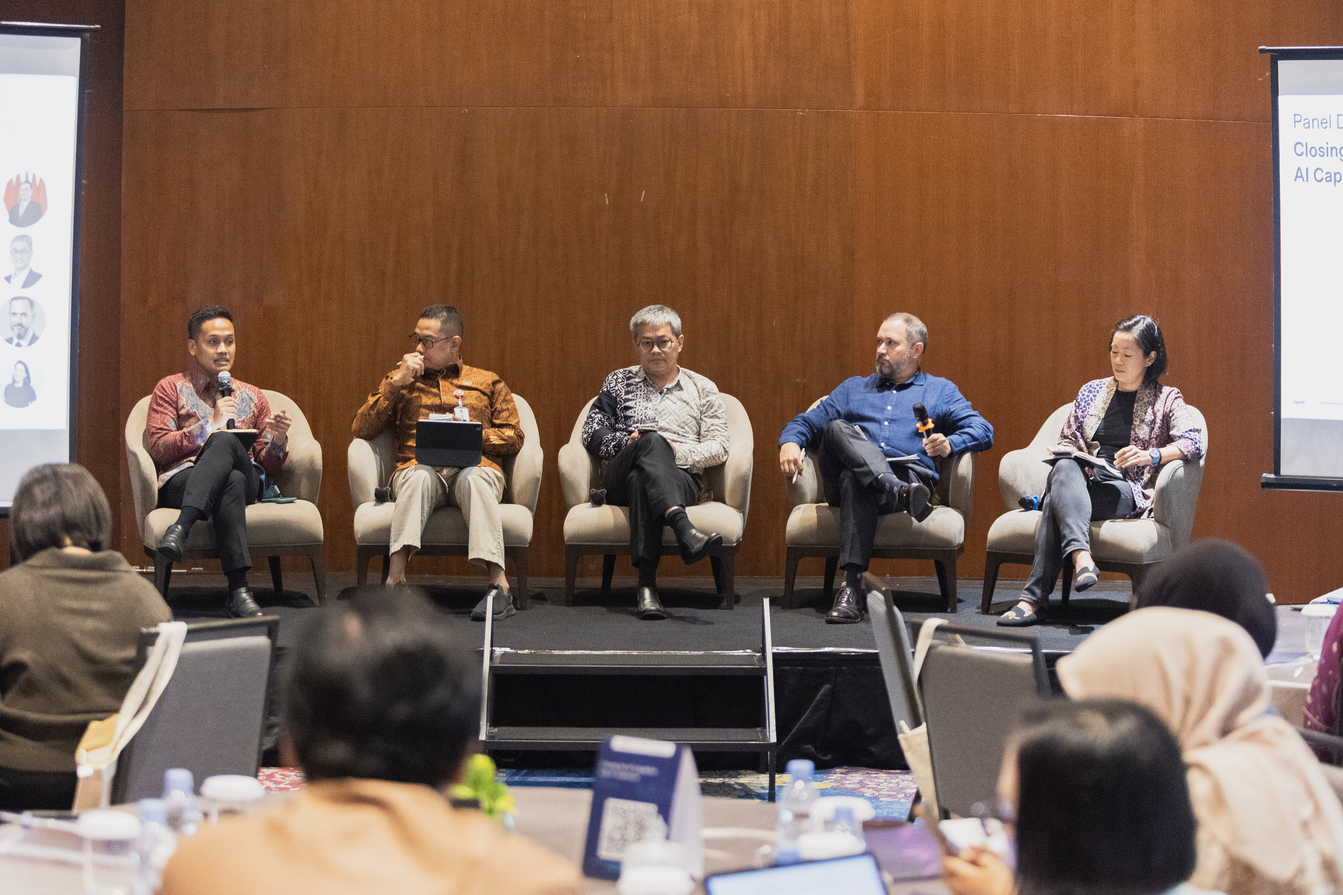
Jakarta, Indonesia – September 2026 – The Southeast Asia Public Policy Institute (SEAPPI) has released its latest policy white paper, Closing the AI Capability Gap in Indonesia, produced with support from OpenAI. The report was launched in Jakarta alongside a discussion bringing together government, industry, and public policy perspectives on Indonesia’s AI opportunity and the policies needed to support wider, more advanced adoption.
The meeting was addressed by Edwin Hidayat Abdullah, Director General of Digital Ecosystem at Indonesia’s Ministry of Communication and Digital Affairs (Komdigi). The panel featured Agung Gumilar Triyanto, Head of the Bureau of Digitalization and Information Management at the Coordinating Ministry for Human Development and Cultural Affairs of the Republic of Indonesia; Even Alex Chandra, a digital policy and regulatory expert who has contributed to Indonesia’s National AI Roadmap and key digital regulations; and Ed Ratcliffe, Executive Director of SEAPPI.
Indonesia is already home to some of the world’s most advanced AI users. OpenAI platform data show that the country ranks in the global top five for ChatGPT use in Codex and data analytics, with advanced users applying AI to increasingly complex and high-value tasks.
However, this capability is unevenly distributed. Users at the 95th percentile in Indonesia draw on more than eleven times as many thinking tokens as the median user, one of the widest gaps measured globally. The paper describes this as Indonesia’s AI capability gap: the difference between what increasingly capable AI tools can do and how most people currently use them.
The economic implications are significant. Kearney estimates that AI could contribute up to US$366 billion to Indonesia’s GDP by 2030, more than one-third of Southeast Asia’s projected total. Capturing this opportunity will depend on whether AI adoption progresses beyond basic uses and reaches more complex tasks across businesses, government, and the wider workforce.
Indonesia has a strong foundation on which to build. Microsoft’s Work Trend Index finds that 92 percent of Indonesian knowledge workers use generative AI at work, while the Ipsos Global AI Monitor finds that 83 percent of Indonesians believe the benefits of AI outweigh its risks. Indonesia’s National AI Strategy 2020–2045 and National AI Roadmap also provide a policy foundation for further adoption.
Speaking at the launch, Ed Ratcliffe, said:
“Indonesia already has a cohort of AI users operating at the global frontier. The opportunity now is to make those capabilities much more widely available across the economy.
“The policy challenge is therefore about more than increasing adoption. Indonesia needs to help workers, businesses, and government agencies use AI for increasingly complex and productive tasks, while putting in place clear and adaptable governance as the technology develops.”
The panel discussion examined how Indonesia can translate high levels of interest and adoption into broader economic gains, including through workforce skills, enterprise adoption, public-sector use, and an enabling regulatory environment.
The white paper identifies four priorities for closing Indonesia’s capability gap:
- Support more advanced private-sector use: Help MSMEs integrate AI into wider digital transformation, strengthen adoption incentives, and expand workforce training and specialist certification.
- Expand public-sector adoption: Establish clearer mandates for government agencies, test high-impact applications, and develop common standards for data, interoperability, and risk management.
- Target sectors where AI can address specific needs: Support appropriate AI adoption in education, healthcare, and financial services, particularly where access to expertise and services remains uneven.
- Provide clear and adaptable regulation: Establish a risk-based national framework, clarify institutional responsibilities, and use sector-specific guidance and regulatory sandboxes as technology and applications develop.
Closing the capability gap would allow Indonesia to build on its existing strengths in AI adoption while extending the productivity benefits of more advanced use across a much larger share of its economy.
Download the full report in English here.
Laporan lengkap dalam Bahasa Indonesia dapat diunduh di sini.
This paper was researched and produced by the Southeast Asia Public Policy Institute with support from OpenAI. The information and analysis presented are based on interviews with relevant stakeholders, publicly available information, and analysis by the authors. It does not represent the views of OpenAI. It is not intended to be an exhaustive review of policy, legislation, or regulation and should be used with due caution and consideration of its scope and limitations.
News and insights

Solar and Beyond: SEAPPI joins discussion on Malaysia’s future energy mix

New Report Series from SEAPPI Explores Southeast Asia Tech Stack Sovereignty