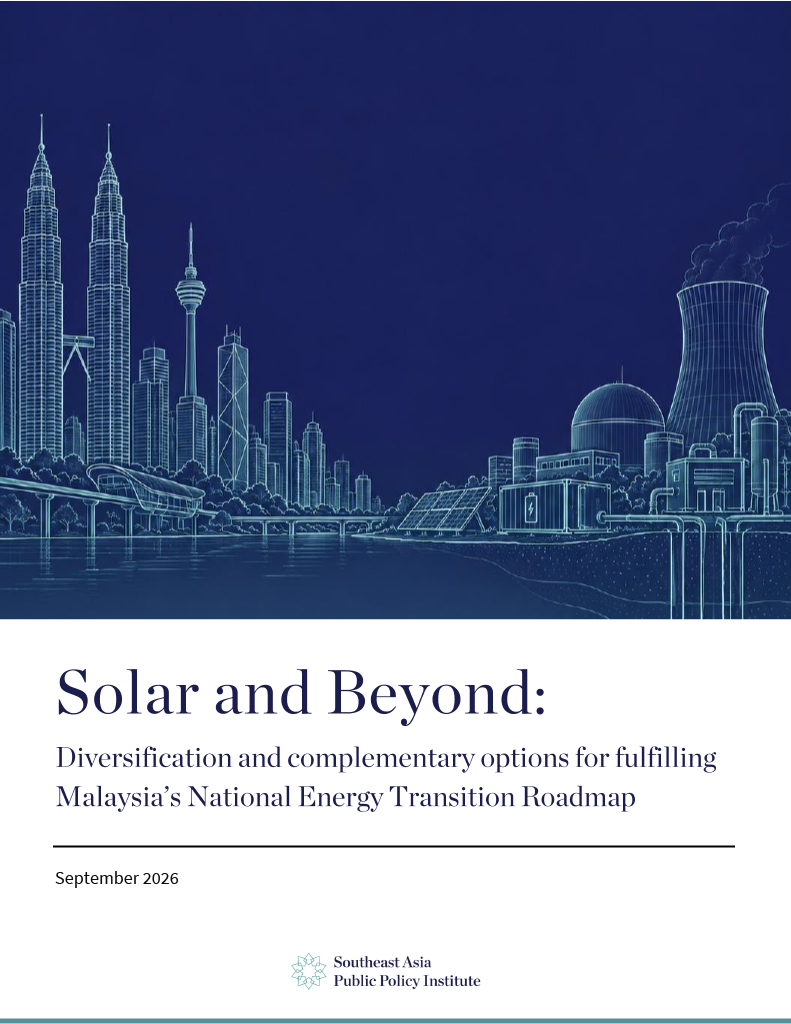
Solar and Beyond: Diversification and complementary options for fulfilling Malaysia’s National Energy Transition Roadmap

Electricity demand in Peninsular Malaysia is rising as the economy grows, electrification advances, and cooling needs increase. The National Energy Transition Roadmap (NETR) aims to meet this growth through renewables, with solar driving capacity expansion. The phase-out of coal increases the need for renewable energy to replace retiring generation capacity. Data center expansion adds to this challenge, as meeting continuous electricity demand with daytime solar requires storage at scale and complementary technologies that can deliver power around the clock.
This white paper, produced with support from Princeton Digital Group, examines how diversification can help Malaysia fulfill the NETR’s ambitions while strengthening system reliability. It assesses the constraints of a solar-heavy pathway, explores complementary generation and storage technologies, and identifies policy reforms to support their development. The paper outlines how a broader clean energy portfolio can reliably meet continuous demand while building on domestic resources and industrial capabilities to strengthen Malaysia’s energy security.
Key Insights
- Solar has driven Malaysia’s renewable energy expansion: Successive policies, from feed-in tariffs to large-scale solar procurement and corporate renewable electricity purchasing, have helped attract investment and scale deployment. The NETR targets renewables reaching 70% of installed electricity generation capacity by 2050. Meeting this ambition will require greater attention to how different technologies work together to serve demand.
- A solar-heavy pathway faces three structural constraints: A solar-heavy pathway faces three structural constraints: Land requirements, limited storage deployment, and rising round-the-clock demand make diversification increasingly important. Replacing baseload power with solar requires substantial generation capacity and land for storage and supporting infrastructure, where developable land is already contested. Battery storage deployment has also lagged behind solar expansion. These challenges become more consequential as coal capacity retires and data centers increase demand for continuous power.
- Next-generation geothermal could combine reliable power with domestic capabilities: Closed-loop advanced geothermal systems extract underground heat without requiring naturally occurring hot-water reservoirs, widening potential development locations. Next-generation geothermal could provide continuous electricity with a small surface footprint while drawing on Malaysia’s oil and gas drilling expertise.
- Long-duration energy storage can extend solar’s contribution: By storing excess solar electricity during the day and releasing it overnight or during prolonged periods of low sunlight, LDES can help bridge the gap between variable solar output and continuous demand, making solar a more reliable part of Malaysia’s energy mix.
- Nuclear offers a longer-term low-carbon option: Nuclear could provide continuous power, but Malaysia would need substantial preparation in areas such as regulation, financing, workforce development, and waste management. These requirements make nuclear a longer-term consideration.
Policy Recommendations
- Operationalize RE Diversification Under NETR: Conduct an interim NETR review and adopt a system-value framework alongside headline capacity targets.
- Clarify Regulatory Pathways for Firm, Domestic, and Storage-Backed Resources: Establish licensing, resource ownership, permitting, and grid access frameworks for non-solar firm resources, starting with a national geothermal policy.
- Reform Procurement Mechanisms and Feed-in Incentives: Publish the methodology behind the System Access Charge (SAC), which determines grid access fees under the Corporate Renewable Energy Supply Scheme (CRESS). Set the charge according to how each of its six customary cost components applies to a given technology. Malaysia should also consider a Feed-in Premium (FiP) and update Feed-in Tariff (FiT) categories.
This paper was researched and produced by the Southeast Asia Public Policy Institute with support from Princeton Digital Group. The information and analysis presented are based on interviews with a range of government and private sector stakeholders, publicly available information, and analysis by the authors. It does not represent the views of Princeton Digital Group, nor is it intended to serve as an exhaustive review of policy, legislation, or regulation. It is intended as a practical starting point for further discussion on how to diversify Malaysia’s energy mix, strengthen energy security, and build a reliable, affordable, and sustainable energy system.
Download the full report here.
About the Southeast Asia Public Policy Institute
The Southeast Asia Public Policy Institute is a research institute based in Bangkok and Singapore, working across the region. The Institute’s mission is to support the development of solutions to the most pressing public policy challenges facing Southeast Asia in the 21st century. The Institute works on a range of issues across sustainability, technology, public health, trade, and governance. It convenes dialogues with stakeholders and decision makers to drive discussion on the challenges and opportunities facing markets in the region. The Institute draws on a network of in-market researchers, advisors, and partners to provide insights and recommendations for governments, policymakers, and businesses.
Our Work
Exploring China’s Role in Southeast Asia’s Energy Transition
Framing a Nuclear-Powered Future for ASEAN