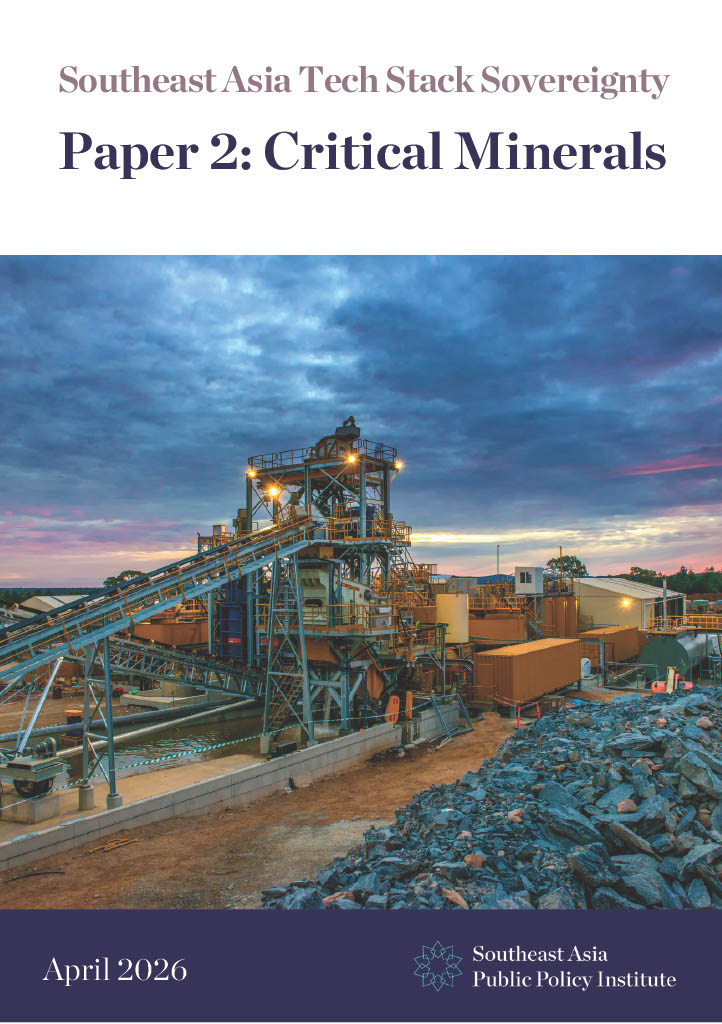
Southeast Asia Tech Stack Sovereignty Paper 2: Critical Minerals

SEA Tech Stack Sovereignty: Critical Minerals is part of a series exploring technology sovereignty in Southeast Asia, developed by the Southeast Asia Institute. This paper builds on the framework presented in our previous paper, Southeast Asia Tech Stack Sovereignty: An Analytical Framework for Understanding Technology Sovereignty, and applies it to the real-world context of supply chains, with a particular focus on critical minerals.
The paper examines how critical mineral sovereignty can be defined within this framework and assesses the current state of sovereignty in Southeast Asia’s critical minerals sector. More importantly, it considers how the region can respond to a rapidly shifting landscape in which critical resources are attracting growing strategic attention worldwide.
Download the full report here.
Key Takeaways
- At the regional level, Southeast Asia has strong access to critical mineral inputs, with substantial critical mineral reserves that position it as an increasingly important supplier to the world. However, its ability to increase value-add (‘capability sovereignty’) remains constrained by dependence on foreign technology and external partners. In terms of governance, there is still no single regional framework or common standard, meaning approaches continue to vary across national contexts.
- Indonesia, Malaysia, and Vietnam stand out for having relatively high levels of sovereignty, particularly because of their critical mineral reserves. Government laws and regulations are also comparatively strong, especially in Indonesia, where export restrictions on critical ores have increased domestic control over these resources. However, technological and innovation capacity remains limited across the countries.
- Limited sovereignty over critical minierals does not necessarily mean that a country will fail to secure its position in the supply chain. Rather, it shapeses the kind of strategy that a country may need to adopt in order to engage more effectively in the technology supply chain.
- Regional coordination can still play an important role in strengthening Southeast Asia’s position and bargaining power, particularly as the region faces growing external pressure from major powers.
Executive Summary
Critical minerals have emerged as some of the most strategic commodities of the 21st century. Minerals such as nickel, cobalt, tin, and rare earth elements are essential inputs for technologies ranging from electric vehicle batteries to semiconductors and wind turbines. Control over these resources has become closely linked to national competitiveness and security. As a result, countries around the world are racing to secure reliable access to them. Southeast Asia has become a major focus in this competition as an important source of critical minerals, making it increasingly important for the region to strengthen its sovereignty in this sector.
Understanding sovereignty in the critical minerals sector provides countries with a strategic lens through which to assess their strengths, identify vulnerabilities, and plan future directions. Building on the broader tech stack sovereignty framework, critical mineral sovereignty can be assessed through three interconnected components
- Access sovereignty goes beyond the mere availability of inputs and considers a nation’s effective control over them through lawful mechanisms.
- Capability sovereignty refers to the technological and industrial capacity to transform raw materials into higher-value products.
- Governance sovereignty concerns the ability to set, implement, and enforce credible rules and standards that shape the sector both domestically and internationally.
The report applies this framework to seven Southeast Asian countries, reflecting the region’s diverse landscape.
- Indonesia leads the region, with vast nickel reserves and extensive smelting capacity, reinforced by assertive export restriction policies that have attracted substantial downstream investment.
- Malaysia has developed a distinctive niche as the only country outside China with a large-scale rare earth separation facility, positioning it as a critical processing hub despite its depleted upstream reserves.
- Myanmar, though rich in tin and rare earth ores, is severely constrained by political instability and fragmented governance, with much of its mineral production operating outside central government control.
- The Philippines holds substantial nickel reserves and is a leading global exporter of nickel ore, but captures limited domestic value because of weak processing capacity and unresolved policy debates over export restrictions.
- Thailand has largely transitioned away from mineral production following resource depletion and instead participates in global supply chains primarily as a downstream end user, particularly in the automotive and electronics sectors.
- Singapore, while possessing no domestic mineral reserves, maintains a strong sovereignty position through advanced technological capabilities, strategic trade openness, and a proactive policy environment.
- Vietnam is an emerging force with significant rare earth and tungsten resources, advanced tungsten processing facilities, and a strengthening regulatory framework, although its rare earth separation capacity remains underdeveloped.
The critical minerals sectors in these countries are shaped by powerful driving forces, especially intensifying US-China geopolitical competition, which has elevated Southeast Asia as a preferred destination for supply chain diversification. However, these opportunities are accompanied by significant challenges, including environmental degradation from unregulated mining and structural dependence on foreign technology and capital.
Southeast Asia may seek to strengthen its position in critical minerals supply chains; one possible path is to pursue a more coherent regional strategy. Moving beyond fragmented national approaches towards a more resilient and complementary regional framework will be essential if Southeast Asia is to exercise meaningful control over its critical mineral resources and secure its place in the global technology landscape.
About the Southeast Asia Public Policy Institute
The Southeast Asia Public Policy Institute is a research institute based in Bangkok and Singapore, working across the region. The Institute’s mission is to support the development of solutions to the most pressing public policy challenges facing Southeast Asia in the 21st century. The Institute works on a range of issues across sustainability, technology, public health, trade, and governance. It convenes dialogues with stakeholders and decision makers to drive discussion on the challenges and opportunities facing markets in the region. The Institute draws on a network of in-market researchers, advisors, and partners to provide insights and recommendations for governments, policymakers, and businesses.
Our Work

Southeast Asia Tech Stack Sovereignty Paper 1: An Analytical Framework for Understanding Technology Sovereignty

Toward Balanced Digital Platform Regulation in APEC