Policy Approaches to Social Media Age Restrictions

Governments across Asia are examining how to protect children from online harms, including exposure to harmful content, online grooming and potentially addictive platform features.
Minimum-age restrictions for social media have emerged as a targeted policy response, but approaches across the region are diverse. While some governments are introducing minimum-age requirements, others are considering graduated safeguards for different age groups, stronger age-assurance measures or greater platform responsibilities.
AUSTRALIA AS A GLOBAL POLICY INFLUENCER
Australia was the first country to implement a nationwide minimum-age requirement for social media accounts, and its approach has become an important reference point for other governments. The regime took effect on 10 December 2025, requiring designated platforms, including Facebook, Instagram, TikTok, YouTube, Snapchat, Reddit and X, to take reasonable steps to prevent users under 16 from creating or maintaining accounts. Rather than penalizing children or their parents, the framework places responsibility for implementation on platforms, which face penalties of up to A$109.2 million for non-compliance. It also gives platforms flexibility in how they verify users’ ages, rather than prescribing a single mandatory verification technology.
Figure 1: Status of Social Media Age Restrictions
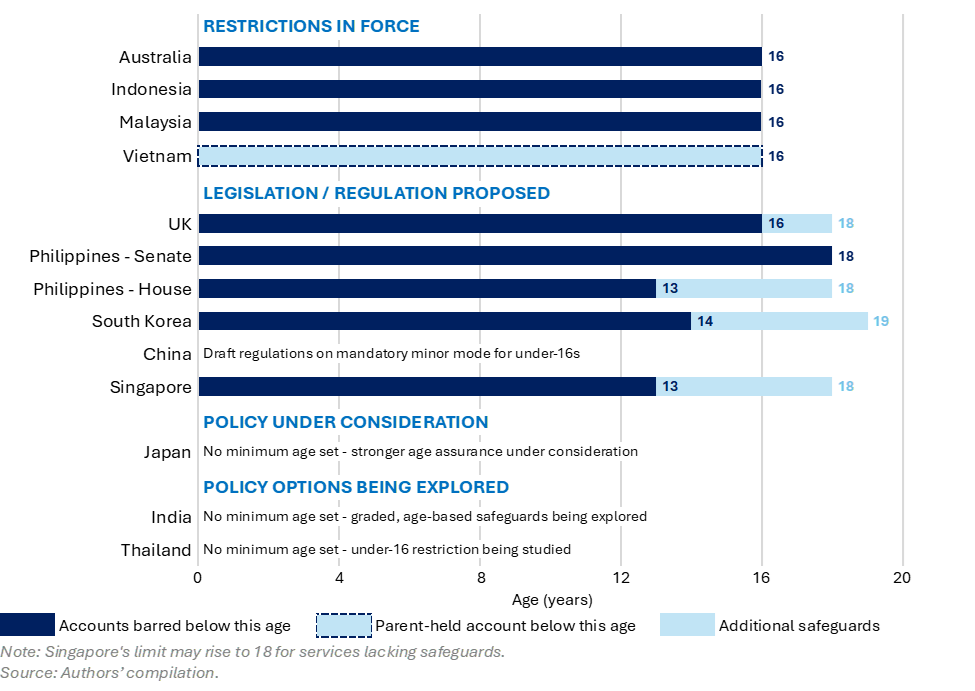
These approaches raise important policy considerations, including how to balance children’s online safety with privacy protections and continued access to digital services. The comparative table at the end summarizes the age thresholds, key policy measures and implementation status across the jurisdictions covered.
FROM AUSTRALIA’S MODEL TO NATIONAL APPROACHES
Indonesia, Malaysia and the UK illustrate how governments are translating minimum-age restrictions into different regulatory frameworks. Indonesia prohibits accounts for users under 16 on designated high-risk digital platforms, and its restrictions extend beyond social media to online gaming platforms such as Roblox. By October 2026, the government reported that TikTok had deactivated approximately 9 million accounts belonging to under-16 users.
Malaysia has combined its under-16 social media account restriction with broader online-safety requirements to protect children from harmful content and reduce online risks. The UK has announced plans to follow Australia’s under-16 approach, but with additional safeguards for 16- and 17-year-olds, including default restrictions on overnight access, autoplay and personalized feeds. Messaging services such as WhatsApp and Signal are expected to be excluded.
DIFFERENT AGE THRESHOLDS AND SAFEGUARDS
Other governments are exploring how protections might vary according to children’s ages and the risks they face online.
Singapore proposes to bar children under 13 from accounts and to require stronger safeguards for users aged 13 to 17. Platforms unable to provide those safeguards may have their minimum user age raised to 18. This builds on existing requirements, in force since 1 April 2026, for designated app stores to use age-assurance measures to prevent users under 18 from downloading age-inappropriate apps.
South Korea is considering a similar split, with restrictions on account creation for children under 14 and design controls for users aged 14 to under 19.

The Philippines illustrates the ongoing debate over how far age-based restrictions should extend. Proposals to restrict children’s access to social media are being considered by both the House and the Senate, with different minimum-age thresholds under discussion. As of October 2026, a House bill would prohibit accounts for children under 13, while the Senate version would extend the restriction to everyone under 18. Both bills passed their third and final reading, but the differences have yet to be reconciled.
China’s draft regulations would require social media, gaming, livestreaming and AI platforms to automatically activate a dedicated “minor mode” for users identified as under 16. The mode would filter harmful content, curb addictive use, protect personal data, and provide parental monitoring tools.
Across these approaches, governments are considering different ways to tailor online protections according to age. While age-specific measures can better account for differences in maturity and online risks, they also require platforms to distinguish between age groups and apply different protections. The choice of age threshold and the scope of restrictions therefore remain important considerations in balancing children’s online safety with their access to digital services.
ALTERNATIVE APPROACHES TO ONLINE SAFETY
Not all governments are pursuing restrictions in the same way. Japan is focusing on stronger age verification, safer platform settings and greater responsibility for technology companies, rather than a blanket ban.
Vietnam requires account authentication and parental involvement, with children under 16 required to have accounts registered by a parent or guardian who supervises their activity. A draft amendment proposes further restrictions, including preventing children under 16 from posting, commenting, sharing or reacting to content on social media.
In India, the Supreme Court emphasized in October 2026 that children have a fundamental right to internet access and that blanket restrictions are impermissible. It pointed to alternatives such as parental oversight, private accounts by default and restrictions on contact from unknown adults.
Thailand has no minimum age for social media. It is studying a possible under-16 restriction and is pushing for child-protection settings to be switched on by default on new devices.
Taken together, these approaches show that protecting children online does not necessarily require blanket minimum-age restrictions. Governments are also considering measures that place greater emphasis on parental involvement, age assurance and platform responsibility. The effectiveness of these approaches will depend on how well they address online risks while protecting children’s privacy and access to digital services.
THE IMPLEMENTATION CHALLENGE: AGE ASSURANCE, ACCESS AND PRIVACY
Different national requirements create compliance challenges for technology companies. Variations in minimum ages, covered platforms and verification methods can increase costs and complexity. Implementing these restrictions also raises questions about how platforms can verify users’ ages without collecting unnecessary personal information. Options include government-issued documents, age estimation and third-party verification. Each involves trade-offs in accuracy, privacy, accessibility and implementation. Digital ID could simplify verification across services, but making it a prerequisite for social media access could create privacy risks and exclude people who lack access to digital identification. Age-verification systems should confirm users’ ages reliably without collecting or retaining more personal information than necessary.
For policymakers, the key question is not only whether to restrict access by age, but how to design and enforce measures that protect children while preserving privacy and appropriate access to digital services.
Download the full briefing here, including a comparative table of age thresholds, policy approaches and implementation status across the countries covered.
News and insights

SEAPPI and ACERD host Manila roundtable on Philippine selective taxation and the ProGRESS Bill

Solar and Beyond: SEAPPI joins discussion on Malaysia’s future energy mix