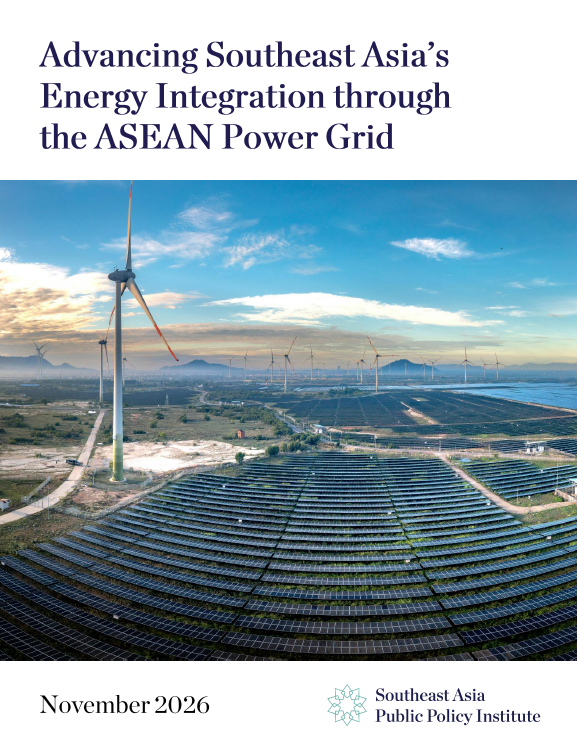
Advancing Southeast Asia’s Energy Integration through the ASEAN Power Grid

Advancing Southeast Asia’s Energy Integration through the ASEAN Power Grid examines how deeper regional cooperation can help Southeast Asia meet rising energy demand while strengthening energy security, affordability, and sustainability.
The report explores the pressures facing national energy systems and considers how connecting countries with different resources and demand patterns can help address these challenges, building on the progress of the ASEAN Power Grid (APG). It also examines the infrastructure, regulatory, financial, and institutional barriers that continue to slow implementation and identifies priorities for translating regional ambition into a cleaner and more resilient energy system.
Recent developments reflect growing regional efforts to advance this agenda. At the 44th ASEAN Ministers on Energy Meeting (AMEM) in October 2026, ASEAN energy ministers welcomed progress on the ASEAN Power Grid (APG), including the finalization of strategic workplans for the APG Task Forces and the development of a Regional Planning Framework for coordinated power-system planning.
The APG is also expected to remain a key focus of regional energy cooperation in 2027, when Singapore assumes the ASEAN Chairmanship. Singapore has identified regional electricity connectivity as a priority and indicated that it will work with ASEAN Member States to secure endorsement of the ASEAN Regulatory Guidelines for Facilitating Submarine Power Cable Activities during its chairmanship, as outlined in Singapore’s statement at the Clean Energy Summit 2026.
Download the full report here.
Key Takeaways
- Southeast Asia’s energy systems face mounting pressure as demand grows while investment remains limited. Climate change affects both electricity generation and consumption, while dependence on imported fuels increases exposure to geopolitical disruptions and price volatility.
- Where national efforts are constrained by differences in resources, geography, and infrastructure, deeper integration can help countries access a wider range of electricity supplies, share reserves, and manage supply and demand more efficiently.
- The ASEAN Power Grid provides an established foundation for regional integration. Operational bilateral connections and the Lao PDR–Thailand–Malaysia–Singapore Power Integration Project (LTMS-PIP) demonstrate how sustained coordination can enable electricity trade between countries with different market structures.
- Regional connectivity can accelerate the energy transition by linking renewable resources with demand centers and helping countries balance variable solar and wind generation across a wider geographic area.
- Realizing the potential of energy integration requires coordinated planning and credible systems for verifying the renewable attributes of traded electricity. Deeper integration also requires stronger domestic grids, compatible technical and market rules, and clearer financing arrangements. Existing regional institutions need sufficient capacity and accountability to translate shared commitments into implementation.
Southeast Asia’s next step, then, depends on its ability to strengthen regional coordination. Stronger domestic grids can lay the groundwork for reliable electricity exchanges, while common rules, supportive financing models, and clearer institutional responsibilities can help these arrangements grow. Sustaining this progress will require trust among countries and a lasting commitment to honoring shared agreements. As cooperation becomes more dependable, the APG can become a foundation for shared resilience, giving countries greater confidence in their ability to meet future energy needs together.
About the Southeast Asia Public Policy Institute
The Southeast Asia Public Policy Institute is a research institute based in Bangkok and Singapore, working across the region. The Institute’s mission is to support the development of solutions to the most pressing public policy challenges facing Southeast Asia in the 21st century. The Institute works on a range of issues across sustainability, technology, public health, trade, and governance. It convenes dialogues with stakeholders and decision makers to drive discussion on the challenges and opportunities facing markets in the region. The Institute draws on a network of in-market researchers, advisors, and partners to provide insights and recommendations for governments, policymakers, and businesses.
Our Work

Solar and Beyond: Diversification and complementary options for fulfilling Malaysia’s National Energy Transition Roadmap
Exploring China’s Role in Southeast Asia’s Energy Transition