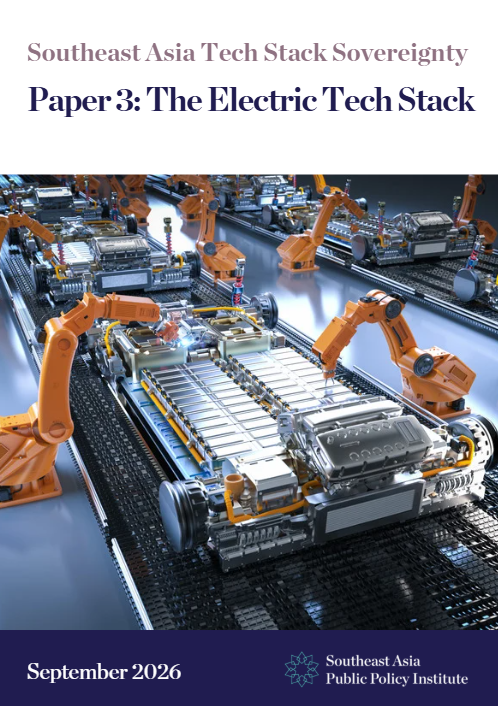
Southeast Asia Tech Stack Sovereignty Paper 3: The Electric Tech Stack

SEA Tech Stack Sovereignty: The Electric Tech Stack is part of a series exploring technology sovereignty in Southeast Asia, developed by the Southeast Asia Institute. This paper builds on the framework presented in our previous paper, Southeast Asia Tech Stack Sovereignty: An Analytical Framework for Understanding Technology Sovereignty, and applies it to the region’s emerging electric technology industries.
The electric technology stack comprises batteries, electric motors, power electronics, and the software that connects them. These technologies support electric vehicles, energy storage, industrial robotics, and defense applications. The paper uses electric vehicle production as its primary analytical lens because EVs are the most commercially advanced and capital-intensive application of the stack.
The paper assesses the six largest ASEAN economies and considers how regional coordination could connect their complementary strengths.
Download the full report here.
Key Takeaways
- Southeast Asia has developed important positions in critical minerals, components, vehicle manufacturing, and market access. However, foreign firms retain control over many core technologies, including battery chemistry, vehicle platforms, software, and system architecture.
- The region’s capabilities are distributed across countries. Indonesia has upstream leverage, Thailand has manufacturing scale, Vietnam has vehicle-integration capacity, Malaysia is strong in components, Singapore leads in governance, and the Philippines has potential in minerals and electronics.
- Production has expanded faster than domestic technological control. Manufacturing participation has developed skills and supplier capacity, but intellectual property and higher-value engineering capabilities remain concentrated outside the region.
- Regional coordination could strengthen ASEAN’s position through shared investment principles, closer research and testing cooperation, and harmonized requirements for battery management, charging interoperability, data governance, cybersecurity, and vehicle-to-grid integration.
Executive Summary
Technologies that store, convert, and manage electricity are becoming increasingly important to transport, energy systems, advanced manufacturing, and defense. Southeast Asia already plays a growing role in these industries through its mineral resources, manufacturing capacity, expanding consumer markets, and government support for electric technology investment.
Electric vehicles are the most commercially advanced and capital-intensive application of the electric stack. Their production brings together many of the technologies, capabilities, and expertise required across the wider stack. The report therefore uses the EV ecosystem as its primary lens for assessing Southeast Asia’s position.
Building on the broader tech stack sovereignty framework, sovereignty within the electric stack can be assessed through three interconnected components:
- Access sovereignty concerns control over resources, supply chains, manufacturing ecosystems, and market entry.
- Capability sovereignty concerns the technology, engineering knowledge, software, and organizational capacity needed to design and improve electric systems.
- Governance sovereignty concerns authority over standards, certification, interoperability, and the regulations governing technologies and markets.
The report applies this framework to the six largest ASEAN economies, which hold distinct positions across the electric technology stack:
- Indonesia has the strongest upstream leverage: its control over nickel access has attracted investment in refining, batteries, and vehicle production, although foreign partners retain many core technologies and much of the operating expertise.
- Thailand has the region’s greatest automotive manufacturing scale: its extensive supplier networks, production facilities, and skilled workforce provide a strong industrial base, but domestic control over EV platforms, software, and system design remains limited.
- Vietnam has the strongest domestic system-integration capability: VinFast designs and integrates its own vehicles, although this capacity remains concentrated in one company and depends on external suppliers for battery cells and other core technologies.
- Malaysia holds an important position in components: its semiconductor, power-electronics, and automotive-component industries are deeply integrated into global supply chains, although it has limited ownership of complete vehicle systems and technology platforms.
- Singapore has strong governance capacity: it has developed advanced rules for charging, certification, interoperability, and grid integration, but its limited market and manufacturing scale constrain its wider influence.
- The Philippines has potential through its nickel resources and electronics industry: but limited domestic processing and EV manufacturing currently restrict its value capture and technological capabilities.
Electric technology industries in Southeast Asia are shaped by rising investment, competition among governments to attract manufacturers, and continued dependence on foreign technology and capital. Production has expanded faster than domestic ownership of core technologies. Manufacturing participation has developed workforce skills and supplier capacity, but it has produced limited accumulation of intellectual property and system-level knowledge.
Southeast Asia could strengthen its position through a more coordinated regional strategy. Common principles for investment and capability development, closer cooperation among research and testing institutions, and harmonized regulatory requirements would help connect the region’s complementary strengths. This could increase ASEAN’s influence over the technologies and rules that will shape its future industries.
About the Southeast Asia Public Policy Institute
The Southeast Asia Public Policy Institute is a research institute based in Bangkok and Singapore, working across the region. The Institute’s mission is to support the development of solutions to the most pressing public policy challenges facing Southeast Asia in the 21st century. The Institute works on a range of issues across sustainability, technology, public health, trade, and governance. It convenes dialogues with stakeholders and decision makers to drive discussion on the challenges and opportunities facing markets in the region. The Institute draws on a network of in-market researchers, advisors, and partners to provide insights and recommendations for governments, policymakers, and businesses.
Our Work

Southeast Asia Tech Stack Sovereignty Paper 2: Critical Minerals

Southeast Asia Tech Stack Sovereignty Paper 1: An Analytical Framework for Understanding Technology Sovereignty